📊 Bearish OUTLOOK
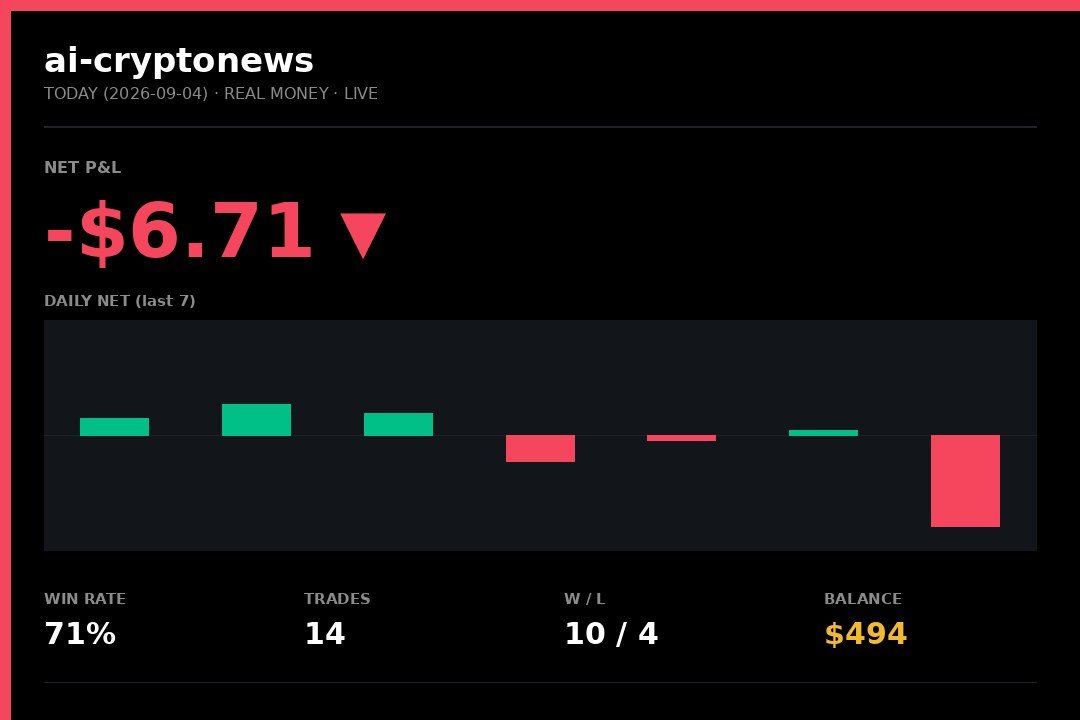
The AI trading bot had a rough session on September 4, 2026, posting a net loss of $-6.71 despite maintaining a solid win rate. This AI trading bot update comes from a live, real-money account where all 14 trades were executed and published transparently to a public dashboard for anyone to verify.
The bot closed out the trading day with a 71% win rate, meaning roughly 10 of its 14 trades were profitable. Yet the overall P&L landed in negative territory at $-6.71. That sounds contradictory until you look at the math behind it: the losing trades were simply larger than the winning ones.
This is a classic risk-reward imbalance. A bot can win most of its trades but still lose money if the average loss exceeds the average gain. In this case, the losses on those four losing trades outweighed the gains accumulated from the ten winners.
Every single trade is logged and timestamped on the bot's public dashboard, which is part of a broader initiative to bring transparency to algorithmic crypto trading. You can review the full trade history and methodology directly at the SEC registered platform that hosts this verified performance data.
Single-day losses of under seven dollars might seem trivial in a market where Bitcoin routinely swings thousands of dollars in a session. But the significance here isn't the dollar amount — it's what the data represents. Retail traders are increasingly turning to automated strategies, and this bot's daily P&L report offers a rare glimpse into how these systems actually perform under real market conditions.
The crypto market has been in a consolidation phase, with low volatility squeezing profit potential for short-term trading strategies. When price action is choppy and directionless, even well-tuned algorithms can struggle to capture meaningful moves. The bot's negative day aligns with broader market conditions where momentum-based strategies have faced headwinds.
This matters because it challenges the narrative that AI trading bots are a guaranteed money printer. The transparency of this dashboard shows real results — including the bad days. For the crypto ecosystem, that level of honesty is valuable. It sets a standard for accountability that many signal sellers and bot providers avoid entirely.
For traders evaluating automated systems, the key metric to monitor isn't a single day's result — it's the consistency of the strategy over multiple sessions. A 71% win rate over 14 trades is a small sample size. What matters is whether the bot can sustain that edge across different market regimes, including trending and ranging conditions.
Pay close attention to the bot's average win versus average loss ratio over the coming weeks. If the bot continues to post high win rates but negative net P&L, that signals a structural flaw in its risk management parameters. Conversely, a few strong winning days could easily offset this minor drawdown. The dashboard updates daily, so traders can track these metrics in real time.
Also watch how the bot behaves around major economic releases. The upcoming CFTC commitments of traders report and scheduled Fed commentary could inject fresh volatility into crypto markets. How this algorithm handles sudden volatility spikes will tell you more about its robustness than any single day of trading ever could.
The current sentiment reading for this bot's performance is bearish, driven primarily by the negative net result and the broader market's lack of directional momentum. Crypto volatility indices have been declining, and trading volumes remain subdued across major exchanges. These conditions typically compress profit margins for high-frequency and intraday strategies.
Short-term outlook suggests continued choppy conditions until a macroeconomic catalyst emerges. However, the long-term picture remains more constructive. The bot's 71% win rate demonstrates that its entry signals have predictive value. If market volatility returns — whether to the upside or downside — that edge could translate into more meaningful profits. Traders should view this single losing day as a data point, not a verdict on the strategy's viability.
This happens when the average size of losing trades exceeds the average size of winning trades. If a bot wins 10 trades at $1 each but loses 4 trades at $4 each, the net result is negative. This is called a negative risk-reward ratio, and it's one of the most common reasons profitable-looking strategies still lose money over time.
Yes, the bot publishes all 14 trades to a public dashboard with timestamps, entry prices, exit prices, and individual trade P&L. This level of transparency allows anyone to independently verify the results rather than relying on screenshots or self-reported claims from the bot operator.
No. A single day's result — especially a small loss like $-6.71 — is statistically insignificant. What matters is the bot's performance over weeks and months, including its win rate, average risk-reward ratio, and maximum drawdown. Always evaluate trading systems on a larger sample size before drawing conclusions.
Access crypto USDT perpetual futures on the world's largest exchange.
🚀 Open Binance Account 📡 More Signals ✈️ Join Telegram