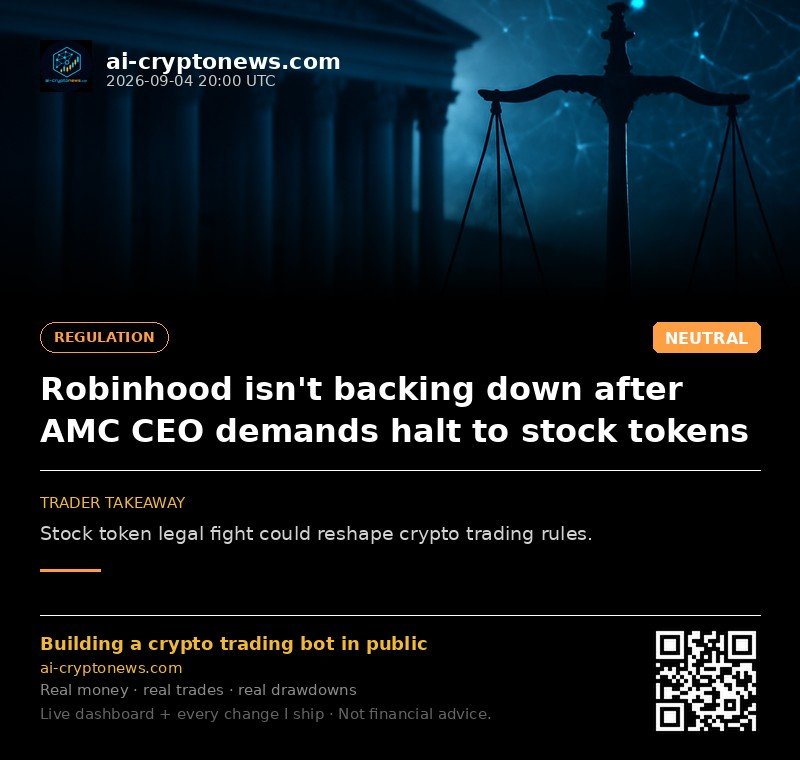
📊 NEUTRAL OUTLOOK
The conflict erupted when AMC Entertainment CEO Adam Aron publicly demanded that Robinhood cease offering tokenized versions of his company’s stock. Aron labeled these products "synthetic equity" and threatened legal action, arguing that the tokens circumvent established shareholder protocols and corporate governance structures. His criticism targeted the core utility of the product, questioning whether token holders possess any legitimate claim to the underlying company.
In a direct rebuttal, Robinhood CEO Vlad Tenev confirmed the brokerage stands firmly behind its stock token product. Tenev emphasized that the tokens are fully backed by actual shares held in custody, positioning the offering as a modernized access point for global investors rather than a shadow market. The company argues that its compliance framework adheres to existing financial regulations, even as it pushes the envelope on settlement technology.
The exchange of words highlights a growing friction point between legacy corporate leadership and fintech platforms experimenting with blockchain rails. While the SEC has not yet issued a formal ruling on this specific product, the agency’s recent enforcement patterns suggest they are watching these developments closely. The outcome of this spat could force regulators to clarify whether tokenized equities fall under the same umbrella as the underlying securities they represent.
This clash is not just a corporate squabble; it is a stress test for the entire concept of real-world asset (RWA) tokenization. If Robinhood is forced to halt its product, it would send a chilling effect across the crypto market, particularly for projects building tokenized commodities, treasuries, or private credit. Conversely, a victory for Robinhood could validate the infrastructure that bridges traditional finance and decentralized ledgers, potentially unlocking a wave of institutional capital.
The market reaction has been cautiously observant. While spot Bitcoin and Ethereum prices have not shown immediate volatility from this news, the sentiment among digital asset traders is wary of increased regulatory scrutiny. The case underscores a fundamental tension: the crypto market thrives on 24/7 accessibility and borderless trading, but these features directly challenge the jurisdictional boundaries that legacy companies like AMC rely upon for control.
Analysts suggest that this dispute could accelerate the push for clearer regulatory frameworks. Lawmakers are already grappling with how to classify digital assets, and the introduction of tokenized equities complicates the narrative further. It blurs the line between a security (like a share of AMC) and a commodity or currency, forcing regulators to consider whether existing laws are equipped to handle hybrid instruments that trade on decentralized networks.
For crypto traders, the immediate focus should be on the legal filings and public statements from both parties over the coming weeks. Any court injunction against Robinhood would likely trigger a sell-off in tokens associated with the RWA narrative. However, traders should also monitor the broader regulatory calendar, as the CFTC and SEC often use high-profile disputes to signal their stance on novel financial products.
Key signals to track include the tone of the SEC’s public commentary and any formal inquiries sent to Robinhood regarding the token's structure. Additionally, watch the trading volumes on Robinhood’s crypto arm; a significant drop might indicate user hesitancy, while sustained interest would suggest retail traders are unfazed by the legal noise. The response from other brokerages is also critical—if competitors like Fidelity or Schwab express interest in similar products, it indicates the market views this as a viable frontier.
On the technical side, look for correlation shifts between AMC’s traditional stock price and its tokenized counterpart. A divergence in pricing would suggest inefficiencies or market fragmentation, which arbitrage bots might exploit. However, traders should be cautious about leveraging these positions until the legal standing of the token is clarified, as regulatory action could render the asset illiquid overnight. The uncertainty alone warrants a defensive posture until a definitive ruling or settlement emerges.
The prevailing sentiment surrounding this story is NEUTRAL, reflecting a market that is waiting for clarity before making significant moves. On one hand, the prospect of regulatory pushback is bearish for innovation tokens. On the other hand, the fact that a major player like Robinhood is willing to fight for the product suggests a conviction that the legal ground is defensible. This equilibrium is visible in the options market, where implied volatility for related assets has not spiked dramatically.
In the short term, expect sideways action with potential for sharp moves on headline releases. The long-term outlook, however, hinges on the precedent this case sets. If regulators allow the product to operate under strict custody rules, it could pave the way for a hybrid market where traditional assets trade with blockchain efficiency. If they shut it down, the RWA sector will likely pivot toward offshore jurisdictions, creating a fragmented global market. Traders should balance their portfolios to hedge against both scenarios until the path forward becomes clearer.
The legality is currently in a gray area. Robinhood argues that because the tokens are backed by actual shares held in custody, they fall under existing securities exemptions. However, AMC’s CEO disputes this, claiming they are unregistered synthetic products. Until the SEC or a court issues a definitive ruling, the legal status remains uncertain and subject to change.
A traditional share represents ownership recorded on a company's official ledger, typically held by a broker. A tokenized stock is a digital representation of that share on a blockchain, allowing for faster settlement and fractional ownership. In Robinhood's model, the token is designed to be redeemable for the underlying share, but the mechanics of that redemption are central to the current dispute.
In a worst-case scenario, Robinhood would likely be required to unwind the product and return the underlying shares or cash equivalent to token holders. The company has stated it maintains full custody of the backing assets, which would facilitate a redemption process. However, the timeline for such an event is unpredictable and could involve a forced liquidation at market prices.
Access crypto USDT perpetual futures on the world's largest exchange.
🚀 Open Binance Account 📡 More Signals ✈️ Join Telegram