📈 BULLISH OUTLOOK
Imagine sending in a homework assignment and finding out 800 other students did the same thing, and most of them used AI to write it. That is basically what just happened to Solana's security team.
Now, to stop the flood, they are making everyone pay real money just to submit a bug report.
The Solana network ran a bug bounty contest, where security researchers look for weaknesses in the code and get paid if they find something real. Over one month, the program received 809 submissions. The problem? Nearly all of them were thought to be low-effort or AI-generated spam, meaning bots or people using AI tools just churned out reports without doing real work.
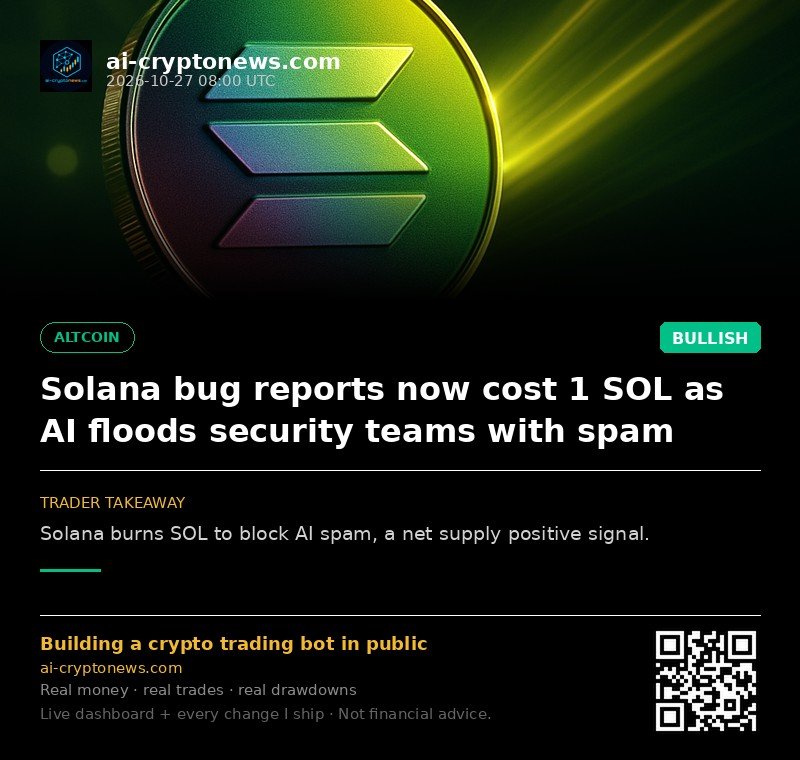
To fix this, Solana's security team announced a new rule. Anyone who wants to submit a bug report must now permanently burn 1 SOL with every submission. Burning means sending that SOL to an address where it can never be used again, basically deleting it from existence. That puts real skin in the game and makes spamming very expensive very fast.
If you hold SOL, this is actually a mild positive. Every time someone submits a bug report, 1 SOL gets permanently removed from the total supply. Less SOL in circulation can put gentle upward pressure on price over time, though the effect depends on how many reports come in.
More importantly, this is a sign that AI spam is becoming a real problem for crypto security programs everywhere. If the teams meant to protect these networks get buried in junk, real bugs could slip through. A safer Solana is better for everyone using it.
Watch whether other blockchain security programs copy this idea. If AI-generated spam is hitting Solana, it is almost certainly hitting others too. The 1 SOL fee sets an interesting precedent, and how the crypto community responds could shape how bug bounties work across the whole industry going forward.
In theory, yes, because it reduces supply over time, which can push prices up if demand stays the same. But the effect from bug bounty submissions alone is likely to be very small.
Burning means sending coins to a wallet address that nobody controls, so they can never be spent or recovered. It is a way of permanently removing tokens from circulation.
The spam problem is frustrating but the team is responding quickly with a real fix. Taking security seriously is generally a good sign for a network's long-term health.
Access crypto USDT perpetual futures on the world's largest exchange.
🚀 Open Binance Account 📡 More Signals ✈️ Join Telegram