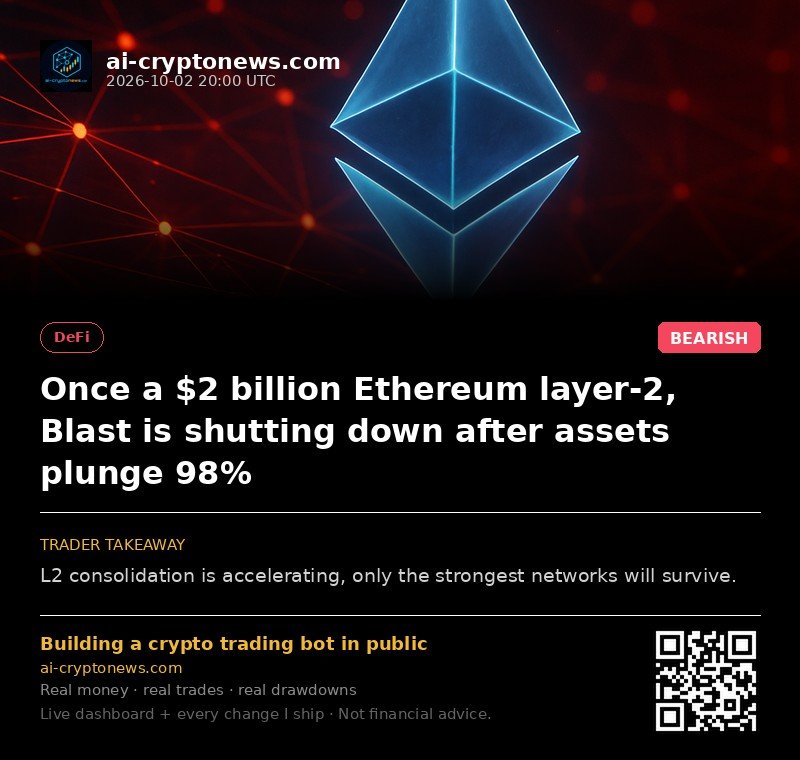
📉 BEARISH OUTLOOK
Two billion dollars. Gone. Not stolen, not hacked, just... slowly walked out the door. Blast, once one of Ethereum's most talked-about networks, is shutting down for good.
Blast launched as a so-called layer-2 network, which is basically a faster, cheaper version of Ethereum that runs on top of it. At its peak, it held more than $2 billion in crypto assets from users. That is a serious amount of money and trust.
But over time, users left, activity dried up, and the costs of keeping the network running kept rising. On top of that, big players like Coinbase and Robinhood started building their own competing networks. Blast simply could not keep up. Assets on the platform have fallen by roughly 98%, and the team has decided to pull the plug rather than limp along.
If you had money sitting in Blast, this is obviously urgent news. You should check how and when you can move your funds out before the shutdown is complete. Even if you were not a Blast user, this is a reminder that even well-funded crypto projects can fail, and parking money in a newer or smaller network always carries real risk.
More broadly, this shows how competitive the layer-2 space has gotten. When Coinbase and Robinhood are building their own networks, smaller players find it very hard to survive. The winners in this space will likely be the ones tied to platforms people already use every day.
Keep an eye on how the Blast shutdown is handled, specifically whether users can easily withdraw their remaining funds and whether the team gives a clear timeline. How other smaller layer-2 networks react to this news is also worth watching, since some may be facing the same pressure.
You should act quickly and move your funds out as soon as possible. Check the official Blast site for withdrawal instructions and any deadlines the team has announced.
A layer-2 is a network built on top of Ethereum to make transactions faster and cheaper. When one shuts down, it signals that the competition in this space is fierce and not every project will survive.
Not directly, since Ethereum itself keeps running no matter what happens to networks built on top of it. But it does raise questions about how many layer-2 projects the market can actually support long term.
Access crypto USDT perpetual futures on the world's largest exchange.
🚀 Open Binance Account 📡 More Signals ✈️ Join Telegram