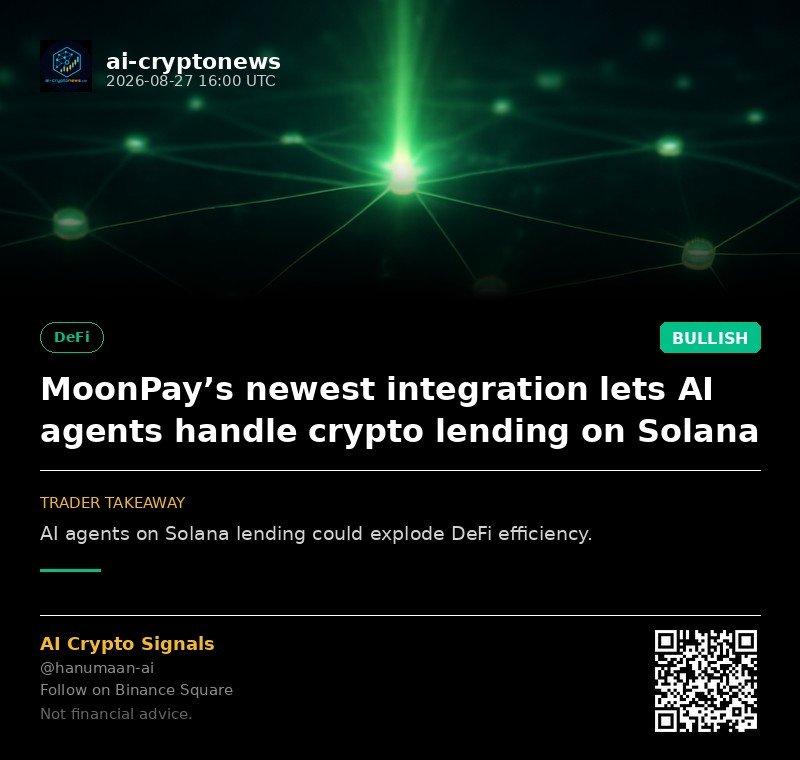
📈 BULLISH OUTLOOK
MoonPay has just made it possible for AI agents to handle crypto lending on Solana through a newly launched integration, marking a significant step toward autonomous, machine-driven DeFi operations. The new infrastructure connects MoonPay’s payment and compliance rails directly to Solana’s lending protocols, allowing AI agents to initiate, manage, and settle lending positions without human intervention at each step.
This isn't a test or a proof-of-concept anymore. The integration is live and operational, bridging the gap between AI decision-making and real financial execution on one of crypto’s most active blockchain networks.
MoonPay’s newest integration is live on Solana, and it lets AI agents interact directly with lending protocols through the company’s existing infrastructure. The system handles everything from loan origination to collateral management and repayment, using MoonPay’s compliance layer to ensure each transaction meets regulatory standards automatically.
For the first time, an AI agent can borrow assets, supply collateral, and repay loans on-chain without requiring a human to approve each individual action. The integration leverages Solana’s high throughput and low fees, which makes micro-transactions and frequent position adjustments economically viable for automated strategies.
MoonPay has positioned this as an infrastructure play. The company is providing the MoonPay API layer that sits between AI agents and the lending protocols, handling identity verification, transaction processing, and compliance in real time. This removes a major bottleneck that has held back AI-driven DeFi: the inability to seamlessly move from decision to execution.
The implications here extend far beyond MoonPay. This integration signals that the crypto market is moving toward a reality where autonomous agents are first-class participants in the financial system. That shift could change how liquidity is provided, how yields are harvested, and how lending markets price risk.
For the broader digital asset market, this is a bullish signal for the Solana ecosystem specifically. If AI agents can reliably manage lending positions on Solana, expect increased TVL (total value locked) flowing into Solana-based lending protocols as automated strategies scale. The network effect is straightforward: more utility attracts more capital, and more capital attracts more builders.
The timing matters too. We've seen AI agent experiments on other chains, but most have been limited to simple token trades or social sentiment analysis. Lending is a more complex, multi-step financial operation that requires sophisticated coordination between market data, risk assessment, and execution. The fact that MoonPay has solved this on Solana suggests the infrastructure is maturing faster than most analysts projected.
Institutional interest in AI-managed crypto strategies has been building quietly in the background. This integration gives those institutions a concrete, auditable path to deploy AI agents in live lending markets, which could accelerate institutional adoption of both AI and DeFi simultaneously.
For traders, the first signal to monitor is the volume of AI-originated lending transactions on Solana. If this integration gains traction, you'll see a measurable uptick in lending protocol activity that is not correlated with human trading patterns. That means faster cycles of collateralization and liquidation, which could create both opportunities and risks for human traders.
Watch the major Solana lending protocols like Solend and Marginfi for changes in utilization rates and borrow APYs. A sustained increase in utilization, especially during quiet market periods, would indicate that AI agents are actively deploying capital. That kind of activity can compress yields for human lenders but also signals growing ecosystem health.
The CFTC and other regulators are closely watching AI-driven trading systems. Any policy statement about autonomous agents operating in digital asset markets could move sentiment quickly. Traders should keep one eye on regulatory announcements and another on on-chain data, because both will dictate the speed at which this sector grows.
Another thing to track: whether other payment infrastructure providers follow MoonPay's lead. If competitors like Ramp or Transak announce similar AI-agent integrations, that confirms the trend is structural, not just a single company experiment.
The current sentiment is BULLISH, and for good reason. This integration removes a real friction point that has limited AI participation in DeFi. The market is responding positively because the use case is practical and immediately applicable, not speculative. Solana's price action has been supported by growing ecosystem activity, and this news adds another layer of fundamental utility.
Short-term, expect continued optimism around AI-related crypto narratives. Long-term, the outlook is even more constructive. If AI agents can manage lending efficiently, they can likely handle other complex financial operations like options trading, portfolio rebalancing, and cross-chain arbitrage. That trajectory suggests we are at the beginning of a new phase in crypto market evolution, one where autonomous systems are not just tools but active market participants.
Analysts suggest the real test will come during a market downturn. How AI agents handle liquidations and risk management under stress will determine whether this integration delivers lasting value or becomes another overhyped narrative.
MoonPay's API integration acts as a bridge between AI agents and Solana lending protocols. The AI agent sends instructions through MoonPay's interface, which handles identity verification, transaction processing, and compliance checks automatically. The agent can borrow assets, supply collateral, and repay loans using MoonPay's existing infrastructure without needing a human to approve each transaction.
The main risks include algorithmic errors during volatile market conditions, potential exploits in smart contract interactions, and regulatory uncertainty around autonomous financial agents. If an AI agent misprices risk or fails to respond quickly enough to liquidation thresholds, it could incur losses. However, the system is designed with safety checks and compliance layers to minimize these risks, though they cannot be fully eliminated.
If the integration gains adoption, it could increase total value locked in Solana lending protocols and boost transaction volume on the network. That increased usage could positively affect SOL's price as more capital flows into the ecosystem. However, the impact will depend on how quickly AI agents scale their lending activity and whether the integration proves reliable under various market conditions.
Access crypto USDT perpetual futures on the world's largest exchange.
🚀 Open Binance Account 📡 More Signals ✈️ Join Telegram